DPDP Act 2023 — Compliance roadmap for Indian businesses in 2026
🧾 Introduction
India's approach to data privacy has undergone a significant transformation with the introduction of the Digital Personal Data Protection Act, 2023 (DPDP Act). The Act establishes a comprehensive framework governing how businesses collect, process, store, share, and protect digital personal data.
With the operationalization of the DPDP Rules, 2025 and the phased implementation approach adopted by the Government, 2026 has become the "readiness and execution year" for Indian businesses. Organizations are expected to move beyond awareness and actively implement privacy controls, governance frameworks, and technical safeguards to prepare for full-scale enforcement.
Whether you operate a startup, MSME, e-commerce platform, SaaS business, healthcare company, financial institution, or multinational corporation, understanding the DPDP compliance roadmap is essential to minimize legal exposure and build customer trust.
⚖️ What is the DPDP Act, 2023?
The Digital Personal Data Protection Act, 2023 regulates the processing of digital personal data in India.
The Act applies to:
✅ Data originally collected offline and later digitized.
✅ Processing activities conducted within India.
✅ Foreign businesses offering goods or services to individuals in India.
The law follows a consent-centric framework that balances innovation with accountability.
📌 Who Must Comply?
The DPDP framework applies to almost every organization handling digital personal data.
Covered Businesses Include:
- Private Limited Companies
- Startups
- MSMEs
- LLPs
- E-commerce Platforms
- EdTech Companies
- FinTech Businesses
- Healthcare Providers
- Professional Service Firms
- Non-Profit Organizations
- Foreign Companies Processing Indian Data
If your organization stores customer names, employee records, mobile numbers, email addresses, payment information, or user analytics digitally, DPDP compliance is likely applicable.
🏢 Key Concepts Under DPDP
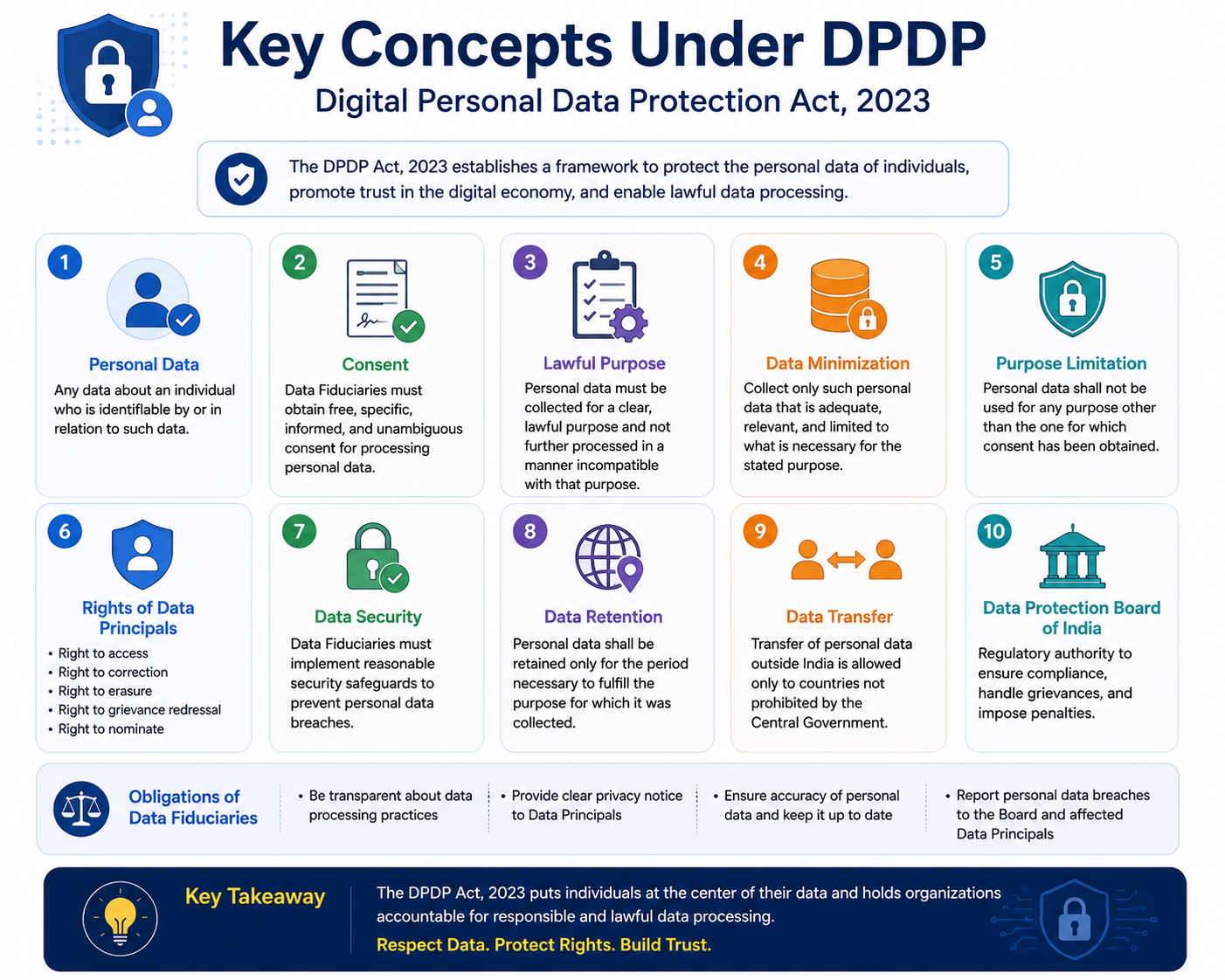 👤 Data Principal
The individual to whom personal data relates.
Examples:
- Customers
- Employees
- Students
- Patients
- Website users
🏛️ Data Fiduciary
The organization deciding the purpose and means of processing personal data.
Examples:
- Employers
- E-commerce companies
- Educational platforms
- Financial institutions
⚙️ Data Processor
Entities processing data on behalf of Data Fiduciaries.
Examples:
- Cloud service providers
- Payroll processors
- CRM vendors
- Outsourced support teams
📅 DPDP Implementation Timeline
| Timeline | Key Milestone |
|---|---|
| August 2023 | DPDP Act enacted |
| November 2025 | DPDP Rules notified |
| 2026 | Compliance readiness and implementation |
| November 2026 | Consent Manager framework operational |
| May 2027 | Full enforcement of substantive obligations |
Businesses should use 2026 to establish compliance programs before full enforcement begins.
🗺️ DPDP Compliance Roadmap for 2026
Phase 1: Conduct Data Discovery & Mapping
Before implementing controls, organizations should understand what data they process.
Identify:
- What personal data is collected
- Sources of collection
- Processing purposes
- Storage locations
- Internal access points
- Third-party sharing arrangements
- Cross-border transfers
Create:
✅ Data Inventory
✅ Records of Processing Activities
This becomes the foundation of the entire compliance framework.
Phase 2: Review Legal Basis for Processing
Businesses must evaluate whether they have lawful grounds for processing personal data.
Assess:
- Consent-based processing
- Legitimate uses permitted under the Act
- Existing consent mechanisms
- Employee data processing practices
Organizations relying on vague or bundled consents should redesign their processes.
Phase 3: Implement Consent Management
Consent lies at the heart of the DPDP framework.
Consent should be:
✅ Free
✅ Specific
✅ Informed
✅ Unambiguous
✅ Capable of Withdrawal
Pre-ticked checkboxes and unclear notices should be avoided.
Businesses should update:
- Website forms
- Mobile applications
- CRM systems
- Registration pages
- Marketing opt-ins
to reflect DPDP requirements.
Phase 4: Update Privacy Notices
Organizations should prepare standalone privacy notices explaining:
- Categories of personal data collected
- Purpose of collection
- Data retention practices
- Rights available to individuals
- Grievance redress mechanisms
- Contact information
The notice should use clear and simple language.
Phase 5: Strengthen Information Security
Technical and organizational safeguards should be reviewed.
Recommended Controls:
🔐 Encryption
🔑 Access controls
🛡️ Multi-factor authentication
💻 Endpoint protection
📂 Backup systems
📋 Incident response procedures
🔍 Security audits
DPDP emphasizes reasonable security safeguards to prevent personal data breaches.
Phase 6: Establish Data Principal Rights Framework
Businesses should create mechanisms enabling individuals to exercise their rights.
These may include requests for:
📌 Access to Information
📌 Correction of Data
📌 Erasure of Data
📌 Withdrawal of Consent
📌 Grievance Redress
Standard operating procedures should define timelines and responsibilities.
Phase 7: Children's Data Compliance
Organizations processing children's data should implement additional safeguards.
This may require:
👨👩👧 Verifiable parental consent
🚫 Restrictions on certain forms of tracking
📋 Age-verification processes
EdTech, gaming, and social platforms should prioritize this area.
Phase 8: Vendor & Processor Due Diligence
Third-party vendors can create major compliance risks.
Review agreements with:
- Payroll providers
- HR software vendors
- Cloud providers
- Marketing agencies
- CRM platforms
- Outsourced processors
Contracts should address:
✅ Confidentiality
✅ Security obligations
✅ Breach reporting
✅ Data deletion obligations
Phase 9: Prepare for Data Breaches
Organizations should establish a breach response plan.
The framework should cover:
Detection
How incidents are identified.
Containment
Immediate control measures.
Investigation
Assessment of impact.
Notification
Escalation and reporting requirements.
Remediation
Preventive improvements.
Regular simulations and tabletop exercises are recommended.
Phase 10: Governance & Accountability
Senior management involvement is critical.
Organizations should establish:
🏛️ Privacy Governance Committee
👨💼 Privacy Lead
📚 Employee Training Programs
📝 Internal Policies
🔍 Periodic Compliance Reviews
Larger organizations should consider formal privacy management structures.
📊 Penalties Under DPDP
Non-compliance can attract significant financial exposure.
Depending on the nature of the violation, penalties may extend to:
 💰 Up to ₹250 Crore
for serious contraventions involving failures such as inadequate security safeguards.
Apart from monetary penalties, organizations may also face:
- Regulatory scrutiny
- Customer complaints
- Reputational damage
- Investor concerns
🌟 Benefits of Early DPDP Compliance
✅ Builds Customer Trust
Privacy-conscious customers prefer transparent businesses.
✅ Improves Investor Confidence
Strong governance supports due diligence.
✅ Reduces Legal Risk
Minimizes exposure to penalties.
✅ Enhances Cybersecurity
Improves resilience against incidents.
✅ Supports Global Expansion
Privacy readiness aligns with international expectations.
⚠️ Common Mistakes Businesses Should Avoid
❌ Copy-pasting generic privacy policies.
❌ Ignoring vendor risks.
❌ Delaying consent redesign.
❌ Failing to train employees.
❌ Treating privacy as an IT-only issue.
❌ Waiting until full enforcement begins.
🏁 Conclusion
The DPDP Act, 2023 marks a fundamental shift in India's digital regulatory landscape. For Indian businesses, 2026 is the year to transition from awareness to execution. Organizations that proactively map their data flows, redesign consent mechanisms, strengthen cybersecurity controls, review vendor relationships, and establish governance frameworks will be significantly better positioned for the next phase of enforcement.
Rather than viewing DPDP compliance as a regulatory burden, businesses should see it as an opportunity to strengthen customer trust, improve operational discipline, and build a sustainable privacy-first culture. As enforcement approaches, companies that act early will not only reduce compliance risks but also gain a competitive advantage in an increasingly data-driven economy.
👉 In the digital age, protecting personal data is no longer just a legal obligation—it is a business imperative.
📲 Stay Connected & Learn More
📞 Reach out via Call or WhatsApp: +91 8802912345
Related Articles
🔒 Cybersecurity Compliance and Data Protection: Safeguarding the Digital World 🖥️💡
In today’s hyper-connected world, data is the new gold. But with great value comes great responsibility — and risks! ? From startups to global giants, no business can afford to ignore Cybersecurity Compliance and Data Protection anymore. ?️ Why ...Cybersecurity Compliance for Businesses in Goa
Introduction Goa is rapidly becoming a preferred destination for tourism, hospitality, restaurants, real estate, event management, startups, online businesses, consulting firms, and professional service providers. As businesses in Goa increasingly ...Fintech Startup Compliance in India: RBI, SEBI & Data Localisation Rules (2026 Guide)
India has become one of the world's fastest-growing fintech markets, driven by digital payments, UPI, online lending, wealth-tech platforms, neo-banking, insurtech, and embedded finance solutions. While the sector offers significant growth ...Cybersecurity and Data Protection for Chartered Accountants
In an era marked by increasing digitization and cloud-based operations, the role of chartered accountants (CAs) has evolved beyond number crunching and auditing. Today’s CAs are custodians of highly sensitive financial data, personally identifiable ...Data Protection and Accounting Outsourcing for Germany
Introduction Germany is known for having some of the strictest data protection regulations in the world. For businesses looking to outsource accounting functions, especially to international service providers, ensuring compliance with German data ...