How Indian Firms Handle IRS Reporting for US Businesses
In an increasingly global business environment, Indian firms play a critical role in supporting U.S. companies — both those operating domestically in the U.S. and those with cross-border operations. One of the key responsibilities in such collaborations is complying with U.S. Internal Revenue Service (IRS) reporting requirements, which ensure that income, withholding, and ownership data are properly disclosed to American tax authorities.
1. Understanding Key IRS Reporting Obligations
Indian firms involved with U.S. businesses must often navigate multiple IRS forms and reporting regimes, depending on the nature of income, entity structure, and where business activities occur:
a. Withholding and Reporting for Payments to Foreign Entities
-
Form 1042 & 1042-S: Used by U.S. withholding agents to report income (e.g., services, royalties, interest) paid to foreign entities or individuals and taxes withheld on those payments. Indian partners often assist in preparing data for these filings when the U.S. firm engages Indian contractors or suppliers.
-
W-8 Series (e.g., W-8BEN, W-8BEN-E): Foreign entities (including Indian companies or freelancers) complete these to certify their foreign status and claim reduced withholding rates or treaty benefits under the U.S.–India Double Taxation Avoidance Agreement (DTAA).
b. Reporting Ownership and Cross-Border Activities
-
Form 5472: Foreign-owned U.S. companies or foreign companies engaged in U.S. trade must file this form with the IRS to disclose ownership details and report transactions with related parties. This is especially important for Indian-owned U.S. LLCs, corporations, or partnerships.
-
Other Forms (e.g., 3520, 3520-A, 8621, 8865, 8938): For more complex structures (e.g., foreign trusts, PFICs), specialized reporting may be required, and Indian tax advisors help U.S. clients or Indians with U.S. ties comply.
c. FBAR – Foreign Bank Account Reporting
Although not an IRS form per se, the FinCEN Form FBAR (FinCEN 114) must be filed by U.S. persons with foreign accounts over $10,000. Indian accountants support documentation and help clients understand whether they need to file.
2. Key Compliance Frameworks and Intergovernmental Cooperation
FATCA (Foreign Account Tax Compliance Act)
The U.S. FATCA regime requires financial institutions and certain entities abroad to disclose information about U.S. persons’ accounts to the IRS. To facilitate this, India signed an Intergovernmental Agreement (IGA) with the U.S. in 2015, and domestic law changes (in the Income-Tax Act) mandate reporting by financial institutions.
-
Indian firms often help U.S. businesses and global clients understand FATCA obligations, including which accounts or assets are reportable and how to collect required declarations.
-
Forms such as FATCA Form 8957/8966 and related withholding certificates are used in this context.
3. Operational Practices by Indian Firms in IRS Compliance
Indian professional services and outsourcing firms, including chartered accountants (CAs), CPAs, and specialist tax BPOs, handle IRS reporting in structured ways:
a. Specialized Skillsets and Training
-
Indian accountants handling U.S. client work are trained on U.S. Generally Accepted Accounting Principles (US GAAP), IRS tax code updates, and cross-border reporting nuances.
-
Many firms invest in continuous training on tax law changes, reporting deadlines, and software like QuickBooks, Xero, or enterprise tax platforms.
b. Multi-Layer Review and Quality Assurance
-
Work is often reviewed through internal audit layers before delivery, reducing errors and ensuring compliance with IRS conventions and deadlines.
-
Indian firms adopt technology systems such as workflow dashboards, compliance trackers, and cloud-based tools for secure, real-time collaboration.
c. Documentation and Recordkeeping
-
Detailed financial documentation, reconciliations, and supporting evidence are maintained in formats suitable for IRS audits and cross-border tax reviews.
-
Cross-reference systems, audit trails, and secure storage protocols (often ISO or SOC certified) help ensure data integrity.
4. Role of Tax Treaties and DTAA Benefits
The U.S.–India Double Taxation Avoidance Agreement plays a critical role in IRS compliance for Indian firms and properties:
-
By submitting W-8 forms, Indian entities can often claim reduced withholding rates on dividends, interest, or service payments.
-
DTAA provisions also help avoid or mitigate double taxation, ensuring that income is not taxed both in the U.S. and India.
-
Accurate treaty benefit claims require documentation, certificates of residency, and adherence to specific IRS criteria.
5. Structuring U.S. Entities and Reporting Responsibilities
Indian business owners or firms establishing U.S. entities (e.g., LLCs, corporations) must adhere to U.S. IRS filing requirements:
-
Corporate returns (Form 1120, 1120-S), Partnership returns (Form 1065), and related schedules must be filed with the IRS. Indian advisors support bookkeeping, tax provisioning, and reporting.
-
Even entities with no income often need zero-return filings or informational returns to satisfy IRS obligations.
6. Challenges and Risk Management
a. Complex Cross-Border Tax Rules
-
Tax rules differ significantly between India and the U.S., especially in defining source of income, residency, and withholding rules, making compliance challenging.
-
Misclassifying a worker, misunderstanding withholding obligations, or failing to file the right form (e.g., confusing Form 1099 vs. 1042-S) can trigger penalties.
b. Penalties and IRS Enforcement
-
Late or incorrect reporting of payments, withholding, or ownership can lead to significant penalties from the IRS — including fines tied to unfiled or inaccurate Forms 1042 or 5472.
c. Cultural & Operational Coordination
-
Differences in business culture, time zones, and legal expectations underscore the need for clear communication protocols and standard operating procedures between U.S. clients and Indian service teams.
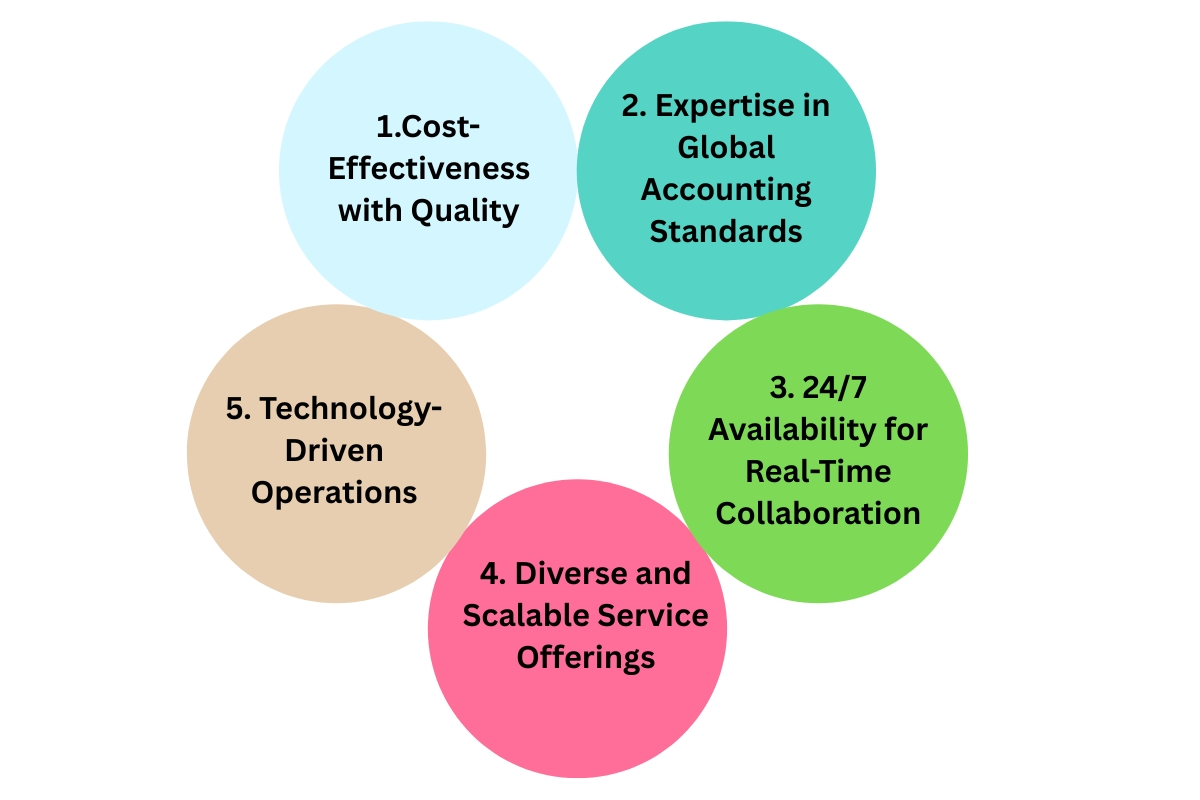 7. Strategic Advantages of Indian Firms in IRS Compliance
Despite complexities, Indian firms provide strong value through:
-
Cost efficiency compared to in-house U.S. resources.
-
Time zone benefits — turning around work while U.S. offices are offline.
-
Scalable support models for tax seasons and year-round compliance.
-
Comprehensive end-to-end services, from bookkeeping and tax filing to international treaty optimization and advisory planning.
Conclusion
Handling IRS reporting for U.S. businesses from India involves more than just preparing forms — it demands nuanced understanding of international tax rules, IRS reporting requirements, careful documentation, and continuous compliance management. Indian firms have emerged as trusted partners for U.S. entities and Indian companies alike by blending technical expertise, compliance rigor, and cost-effective execution.
Whether you are an Indian firm advising U.S. businesses, an Indian entrepreneur owning a U.S. entity, or a U.S. company outsourcing tax reporting, the key to successful IRS reporting lies in thorough documentation, correct forms, timely filings, and leveraging international tax treaties like the DTAA.
📲 Stay Connected & Learn More
👉 Join our WhatsApp Channel for regular updates & insights:
👉 Explore more informational content on our YouTube Channel:
📞 Reach out via Call or WhatsApp: +91 880291234
Created & Posted by Sony Garg
Finance Executive at TAXAJ
TAXAJ is a consortium of CA, CS, Advocates & Professionals from specific fields to provide you a One Stop Solution for all your Business, Financial, Taxation & Legal Matters under One Roof. Some of them are: Launch Your Start-Up Company/Business, Trademark & Brand Registration, Digital Marketing, E-Stamp Paper Online, Closure of Business, Legal Services, Payroll Services, etc. For any further queries related to this or anything else visit TAXAJ.
Related Articles
New FATCA Reporting Deadline Announced for Indian Banks
? New FATCA Reporting Deadline Announced for Indian Banks ? Updated Compliance Timeline | July 2025 The Income Tax Department of India has issued a revised deadline for FATCA (Foreign Account Tax Compliance Act) reporting by Indian financial ...Tax Implications of Cross-Border Airdrops and Staking Rewards
? Tax Implications of Cross-Border Airdrops and Staking Rewards: What Every Crypto Holder Must Know As the world of crypto continues to break borders, airdrops and staking rewards have emerged as attractive incentives for blockchain participants. ...How Indian Accounting Firms Support SARS Compliance
How Indian Accounting Firms Support SARS Compliance As trade and investment between India and South Africa continue to grow, many Indian businesses are expanding operations, forming subsidiaries, or entering joint ventures in South Africa. With this ...Compliance Requirements for Cross-Border Angel Investors in India
?️ Compliance Requirements for Cross-Border Angel Investors in India Author: Taxaj Corporate Services LLP Category: International Investment Compliance | Indian Regulatory Framework ? Introduction India has emerged as a hub for startups and ...DTAA — How to claim relief & Form 67 filing for foreign income
With the rise of global employment, freelancing, overseas investments, remote work, and international business transactions, many Indian taxpayers now earn income from foreign countries. One major issue faced by such taxpayers is: Double Taxation ...